
Winter Special Halwa
You know right that winters in India is basically ‘halwa’ time! The minute it gets chilly, every kitchen household starts bubbling with slow-cooked halwas made from winter veggies and nuts. Gajar, lauki, Bananas, Corn flour and even ash gourd…turning them into pure indulgence. And then there are almonds, cashews, pistachios, gond and much more, roasted in ghee to make those cosy, strength-giving winter halwas our families swear by and all the goodness that comes with them.
And here’s a fun fact— the word “halwa” comes from the Arabic ‘hulw’, which just means “sweet.” It wasn’t even born here. It originated from Persia and Arabia as a super simple sweet made with dates and milk, travelled to India, and then we gave it our own twist with coconut and jaggery.
Culturally, halwa holds a ritualistic place in many weddings, community feasts and even caterers. Each region offers its own iconic version and some even host a dedicated halwa counter.
But beyond the flavours and the history, the halwas I grew up eating were honestly to die for.
I still recall my winter vacations when I was a child — they were a feeling, memories that I hold very close to my heart even today. A slow, warm, silken emotion that wrapped itself around those days we spent waiting… just waiting… to run to our Nani’s home. It was the kind of excitement that made time feel slow, like the days themselves knew we were yearning for something special.
That journey—Cheema (a bit beyond Amritsar), the small train, Patti, the tonga ride felt like entering another world. A world where life was unhurried, where love lived in everyday things, and where the scent of warmth drifted through the cold air long before we reached my Nani’s doorstep.
Back in those days, every house in the village had 5-6 cows and buffaloes—milk was everywhere, fresh, pure, alive. And along with it came one ritual that defined our winters: the making of khoya. My Nani would take a huge kadhai, pour in milk and let it reduce overnight on a slow-cooked flame from cow-dung cakes. There was something special about it.
At dawn, my Nani would pour the warm khoya into earthen pots and hang them high on the roof. And that’s where our little mischief began. As children, we’d stack stools and chairs on top of one another, little ladders built only for one mission: to steal a tiny bit of that khoya — That one sneaked-in bite made our day.
But the true magic, the joy that made our hearts beat faster, was the wait for my Nani’s Gajar ka halwa. Not the 1 kg batch you see today—no! This was 10kgs of desi gajar, lovingly grated, mixed with milk in a giant kadhai, and left to cook slowly through the night. She would cover it with a muslin cloth, and the entire house would be filled with that soul-soothing scent—sweet, warm, familiar, almost like a lullaby drifting through the cold winter air.
By morning, the kadhai held a treasure—soft carrots melted into milk. Nani would add generous desi ghee, roast the nuts till aromatic, mix it all together, and then fold in the khoya, letting it simmer slowly for 4-5 hours. Time didn’t hurry then. And neither did love. She’d store the halwa in pots to deepen its flavour, and every day of our stay, we’d get a fresh bowl—waiting for it with the same excitement, as if it were the very first time.
We’ve tasted halwa in countless ways, and honestly, it has its own kind of magic right? Desi ghee for warmth, ginger-powder and nut halwas to fight the cold—those memories still shape my cooking. At my restaurant, Karigari, our ‘Kali Gajar ka Halwa’ is my tribute to my Nani, and our newly introduced ‘Akhrot-Anjeer ka Halwa’ carries that same warmth and heart.
Some memories never fade, and halwa is one of them. Even today, it overwhelms me in the best way. Come winter, a warm halwa doesn’t just finish the meal—it completes the moment. And really, who doesn’t love halwa?
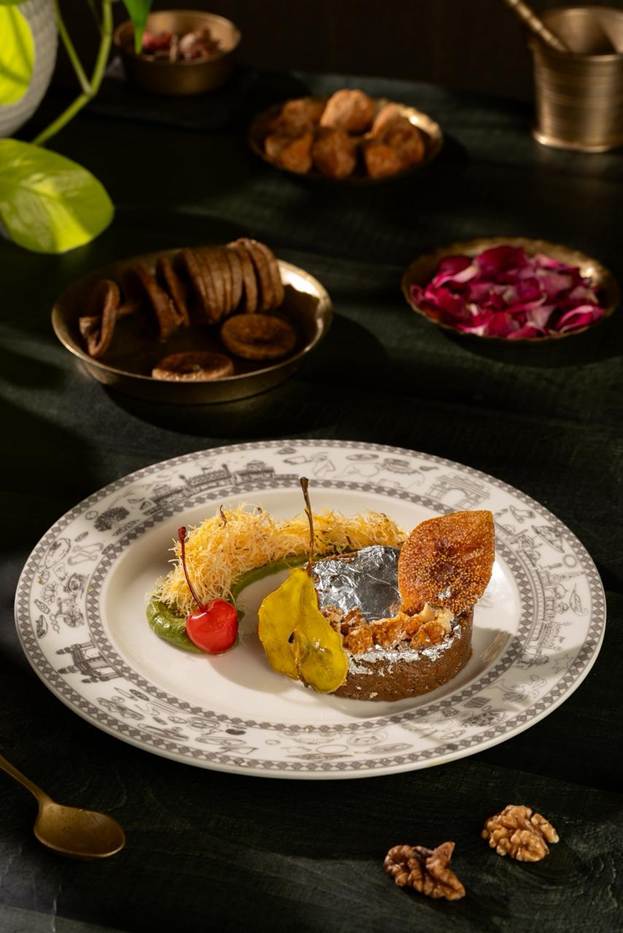
Akhrot-Anjeer Ka Halwa
Ingredient Quantity
For Halwa:
Dried Anjeer (Figs) 200 Gm.
Walnuts (Akhrot), 200 Gm.
Suji 50 Gm.
Ghee 200 Gm.
Full Cream Milk 1 Ltr.
Water 150 Gm.
Jaggery 200 Gm.
Fennel Powder (Saunf Powder) 5 Gm.
Dry Ginger Powder (Sonth Powder) 1 Gm.
Saffron strands 0.5 Gm.
Green Cardamom powder 5 Gm.
Pistachio Sauce:
Pistachio 100 Gm.
Milk 100 Gm.
Condense Milk 60 Gm.
For Garnish:
Karafi Roasted 15 Gm.
Dehydrated Pears 1 Slice
Dehydrated Anjeer 1 Slice
Cherry 1 No.
Method:
Pistachio Sauce
- Soak Pistachios in hot water for 10 minutes, then peel them.
- Add the peeled pistachios and 40 g milk to a blender jar; blend into a smooth paste.
- Transfer the paste to a pan, add the remaining milk and condensed milk, mix well, and cook until the mixture becomes thick and creamy.
- Remove to a bowl and keep aside.
Halwa
- Chop the Anjeer into small pieces and soak in warm water.
- Drain the water, add 150 gm. milk, and grind into a smooth paste. Transfer to a bowl and keep aside.
- In a saucepan, heat jaggery with water on medium flame until fully melted. Transfer to a bowl and set aside.
- Heat 50 gm. ghee in a pan, add the walnuts, mix well, and sauté for 2 minutes.
- Transfer the sautéed walnuts to a grinder jar and pulse to a coarse texture.
- Heat the remaining ghee in the same pan. Add Suji, mix well, and sauté for 2–3 minutes on medium flame.
- Add the Anjeer paste, mix, and cook for 1 minute.
- Add remaining milk, mix well, and cook on medium heat for 2 minutes.
- Add the crushed walnuts, mix, and cook until the milk reduces and the mixture thickens.
- Add the jaggery water, fennel powder, dry ginger powder, green cardamom powder, and saffron. Cook until the halwa leaves the sides of the pan.
- Transfer to a serving bowl. Garnish with dehydrated pears, cherries, and dehydrated Anjeer.
- Serve warm with Pistachio Sauce and Kharafi Roasted toppings.
