
Some seasons don’t arrive loudly. They fade.
And just before winter loosened its hold — when the air softened but still carried a little chill — raw turmeric would quietly enter our home.
It was never about the cold. It was about transition.
I remember the mandi at that time of year. Not harsh winter mornings, but gentler ones. The mustard fields are already glowing somewhere beyond the city. And in small heaps on jute sacks lay fresh turmeric — imperfect, knotted, still smelling of damp earth. Long before “curcumin” became a buzzword, our grandmothers understood raw (fresh) turmeric. My grandmother would pick them up one by one, rubbing off the soil with her thumb, inspecting them the way only someone who understands seasons can. She wasn’t just buying the golden spice. She was choosing time.
Ever held a raw turmeric root in your hands? At home, there was always that familiar warning:
“Haldi lag jayegi, daag nahi niklega.”
And maybe that’s why it stays with me. Because some things aren’t meant to wash away.
“Unhone sirf kachchi haldi nahi kharidi thi mandi se uss din,
Woh meri sehat, meri umr aur mera kal chunn laayi thi.”
The little crackling sound of mustard oil would fill the kitchen first — soft, steady, almost like a heartbeat finding its rhythm. Hing releasing that sharp whisper. Jeera dancing in the heat. Then the grated fresh haldi — raw, intense, almost too honest — would touch the kadhai. The aroma wasn’t merely fragrant; it was grounding. Earthy. Healing. Alive.
No rush. Just patience. Just presence.
This recipe has never been showy. No rich gravies. No heavy spices hiding behind complexity. It tasted real — slightly bitter, deeply warm, strangely comforting. The kind of taste you understand only as you grow older.
In Punjab and Rajasthan, the ‘Kachchi Haldi ki Sabzi’ marked a moment when the body prepared for change. When winter was ending but summer hadn’t begun. It strengthened. It reset. It reminded you that nature moves gently, not abruptly.
For over four thousand years, turmeric has grown in Indian soil. It has colored wedding rituals, anointed brides and grooms, healed wounds, nourished new mothers, and flavored everyday meals. It was never just a ‘golden spice’. It was ceremony. It was science. It was faith woven into food.
Today turmeric travels the world in new disguises — golden latte in New York, immunity shots in Melbourne, capsules in London, luxury serums in Seoul. Farm-to-table is fashionable. Ayurveda is global. Turmeric is a superfood.
And yet, somewhere between modular kitchens and microwave dinners, the humble Kachchi Haldi ki Sabzi slipped quietly out of memory.
As families grew smaller, recipes grew silent. Steel and bronze thalis gave way to porcelain plates. Slow winter afternoons dissolved into rushed evenings. What once simmered patiently now competes with the clock.
But every year, when I see fresh turmeric in the market just as winter begins to retreat, something in me tightens gently. I see her hands again — stained yellow, steady, sure. I hear the crackle of jeera.
Reviving the root of raw (fresh) turmeric isn’t nostalgia for a colder time.
It is longing for a slower heartbeat.
For food that aligned with the sky.
For kitchens that carried memory in their stains.
Because sometimes, the future of food is not invention.
It is a remembrance.
And some stains — like raw (fresh) turmeric — are meant to stay with us forever.
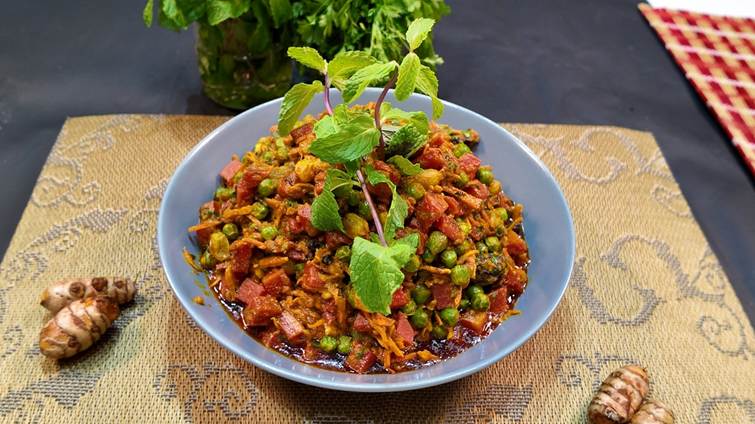
Kachchi Haldi ki Sabzi
Ingredients
2 No – Carrot
Water as required
2 Tbsp – Fenugreek seeds soaked
1 Tsp – Turmeric powder
200 Gm – Fresh raw turmeric
1 Cup – Ghee
¼ Tsp – Asafoetida
½ Tsp – Cumin seeds
5-6 No – Cloves
1 Inch – Cinnamon stick
5 No – Black cardamom
2 No – Onion chopped
1 Tbsp – Ginger chopped
1 Tbsp – Tomato chopped
Salt to taste
2 Tsp – Coriander powder
2 Tsp – Red chili powder
1 Tsp – fennel seeds powder
1 Tsp – black pepper corn
1 ½ Tsp – Dry mango powder
Water as required
1 ½ Cup – Green peas boiled
¼ Cup – Raisins soaked
¼ Cup – Curd
¼ Cup – Coriander chopped
Mint sprig for garnish
Method:-
1. Now take carrot and peel them well then cut it into small cubed.
2. Drain the soaked fenugreek seeds and boil them in fresh water with turmeric powder for 5–7 minutes to reduce bitterness. Strain and keep aside.
3. Wash, peel, and chopped the fresh turmeric. Keep aside.
4. Heat ghee in a heavy-bottom pan. Add chopped turmeric and fry until crisp & golden brown.
5. Add asafoetida, cumin seeds, cloves, cinnamon stick, and black cardamom. Let them splutter.
6. Add chopped onions. Sauté until onions turn golden brown.
7. Add chopped ginger, tomato and salt. Cook until the mixture becomes soft and ghee starts separating.
8. Add coriander powder, red chilli powder, fennel powder, black pepper and dry mango powder. Mix well.
9. Add chopped carrots and boiled fenugreek seeds. Mix well and cook on low flame for 2 minutes.
10. Now add boiled green peas and cook for 2-3 minutes. Add soaked raisins. Stir gently.
11. Whisk the curd and add it slowly to the sabji, cook for 5 minutes.
12. Add dry mango powder and adjust water to desired consistency. Cover and cook for 10–12 minutes on low flame.
13. Finish with chopped fresh coriander.
14. Garnish with mint sprig and serve hot.
